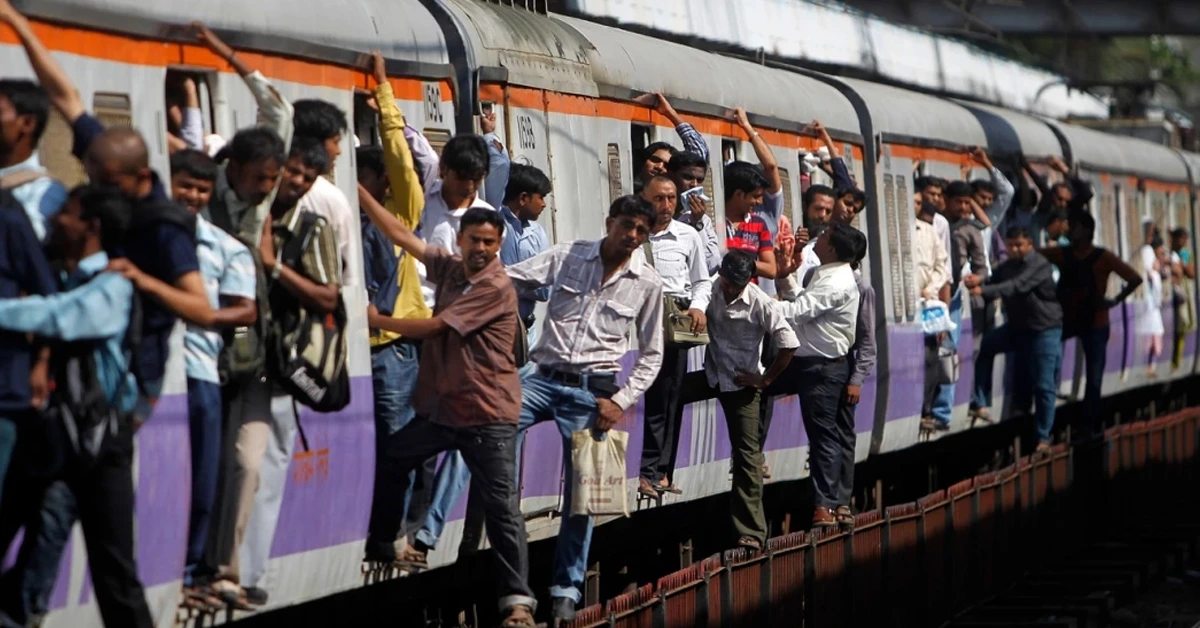
Mumbai’s suburban railway is the city’s bloodstream. It moves over seven million people daily and kills seven to ten of them, every single day.
That arithmetic has been stable for years. When a city normalises a daily death count on its trains, the problem is no longer accidental — it is structural, political and administrative.
These deaths don’t happen in freak circumstances. They happen in full public view: bodies falling from overcrowded coaches, commuters clipped while crossing tracks, people crushed at platforms designed for a city that outgrew them decades ago. The system didn’t collapse overnight; it was allowed to decay in slow motion.
The Numbers Authorities Don’t Argue With
Official data has long shown that Mumbai's suburban network records thousands of fatalities annually. Even in years where authorities point to a "decline," the average still works out to seven or more deaths a day. That is not improvement — it is statistical comfort.
Behind the figures are patterns that repeat with depressing regularity:
Falls from overcrowded trains during peak hours
Trespassing and track-crossing because access infrastructure is inadequate or poorly planned
Platform and foot-overbridge bottlenecks that push crowds into unsafe spaces
These are not behavioural mysteries. They are design failures.
Overcrowding Isn't An Excuse. It's The Core Crime
Mumbai locals run at crush loads that defy basic safety logic. Coaches meant for a fixed capacity routinely carry double or triple that number.
Commuters cling to footboards not out of thrill-seeking bravado but because missing one train can mean losing a job, a day’s wage, or hours stuck on platforms.
Every year, authorities promise more trains, better signalling, newer rakes.
Every year, demand outpaces delivery. The city keeps growing; the railways keep responding with incrementalism. People fall. People die. Files move.
Track-Crossing Deaths Are A Planning Indictment
Officials like to call track-crossing “trespass,” shifting blame onto commuters. But people cross tracks because:
Foot overbridges are too few, too narrow or too far apart
Existing bridges choke during peak hours
Escalators and lifts are absent, broken or badly located
When infrastructure makes the safe choice impractical, unsafe behaviour becomes inevitable. Penalising it without fixing access is administrative hypocrisy.
Safety Exists On Paper, Not On Platforms
CCTV cameras, warning posters, public announcements — Mumbai has them all. What it lacks is real-time crowd management and physical safety barriers at the scale required.
Automatic doors exist on select air-conditioned rakes. Platform screen doors are discussed, piloted, delayed. Anti-trespass fencing appears in patches. Each intervention is introduced like a press release, not a system overhaul.
The result: isolated improvements that look good in presentations but fail to dent the death toll meaningfully.
The Unclaimed Dead Tell Another Story
A deeply uncomfortable reality sits beneath the statistics: thousands of bodies recovered from tracks go unclaimed. Migrant workers, the homeless, the invisible workforce of the city — they die anonymously, absorbed into numbers that barely ripple public discourse. Their deaths don’t trend. Their names don’t reach files.
A city that runs on invisible labour treats invisible deaths as collateral.
What Works — And Why It Hasn't Been Scaled
Targeted interventions have worked where tried seriously: better station design, behavioural nudges backed by enforcement, improved lighting, fencing and trained staff presence. Where crowd flow is managed, deaths drop.
The problem is not knowledge. It is will, urgency and scale.
Small pilots are celebrated; city-wide rollouts stall. Budgets are announced; deadlines dissolve. Responsibility diffuses neatly between the Railways, state agencies and the civic administration — until no one is accountable.
What Must Change — Immediately, Not Eventually
Set a public fatality-reduction target with monthly disclosures. If deaths don’t fall, officials must explain why.
Add capacity aggressively, not cosmetically — more rakes, tighter headways, faster signalling upgrades on the busiest corridors.
Redesign platforms and bridges at choke-point stations. Widen them. Manage them. Staff them.
Make falling impossible, not illegal — automatic doors, fencing, platform barriers wherever feasible.
Enforce after enabling — penalise track-crossing only after safe alternatives are genuinely accessible.
Independent audits, not internal reviews, with findings made public.
Stop Calling This "Unavoidable"
Deaths on Mumbai locals are often described as tragic but inevitable. That language is convenient — it absolves decision-makers and blames density, destiny and commuters themselves.
But cities around the world run high-capacity suburban rail without daily fatalities becoming routine. Mumbai’s problem is not density; it is delay. Not population; but policy inertia.
Every day this continues, seven to ten families pay the price for a system that has chosen to manage numbers instead of saving lives. That is not a transport crisis. That is a moral one.
ALSO READ | Road Accident In Rajasthan: 12 Killed

The Story Mug is a Guwahati-based Blogzine. Here, we believe in doing stories beyond the normal.