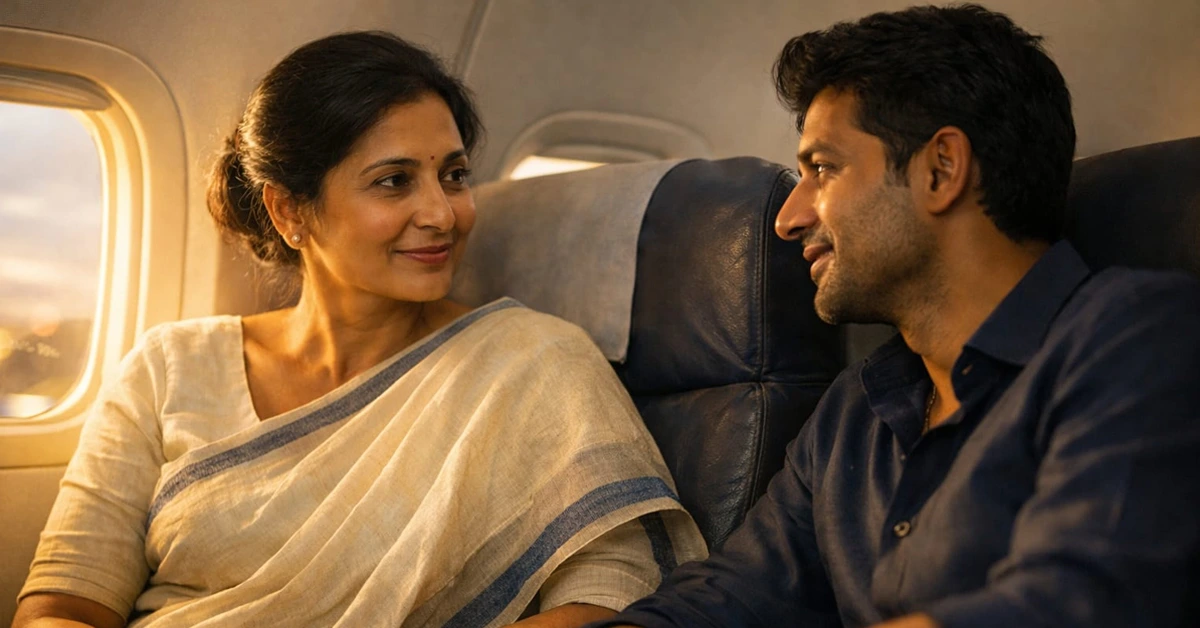
He had boarded the flight, as usual at the last minute. He looked around, almost everyone was seated or were settling down. It was then when he noticed her even before he took his seat. She was seated on his seat, lost in reading a book.
She was not striking in the usual way. Age had softened her features, traced fine lines across her skin. What stood out was the quiet composure she held, steady against the chaos of boarding.
She wore a pale, handwoven saree — off-white with a faint indigo border, faded enough to show age rather than neglect. It was draped with care, though not perfectly; the pleats slightly uneven, as if comfort mattered more than appearance. Her blouse was simple with a plunging neckline, the fabric loose over a body that had made peace with time.
Her wrists were bare except for a thin gold bangle and a small, old-fashioned watch on her left hand. Her hair, streaked with silver, was tied back in a low bun. It wasn’t tight or loose, just settled.
He took all of it in, slowly.
Then, almost instinctively, he became aware of himself.
He wore a deep navy shirt, sharply ironed, with the top button left open on purpose. His slim-fit charcoal trousers were tailored to show discipline but not stiffness. His shoes were polished, and his watch was simple. Everything about him was chosen to seem effortless.
‘We are dressed for different philosophies. She has stopped performing. I never did,’ he thought.
Still, something about her lack of performance drew him in. It was not a challenge to overcome, but something rarer—a space he felt invited to enter.
“I believe that seat is mine,” he said, his voice warm, measured.
She looked up, a brief flicker of surprise crossing her eyes before it settled into politeness.
“Oh, of course. I will move to mine. I was sitting here as its occupant hadn’t arrived,” she replied.
He slid into the aisle seat beside her, careful, unhurried.
“I apologise. I like to board last. Gives me the illusion that I am choosing to leave.”
She smiled faintly. “Or that you can still change your mind.”
“Exactly,” he said, adding, “Though I rarely do.”
“After that crash last month, I sometimes think of not flying again,” she said quietly. “But time does not wait.”
He said nothing.
He adjusted his sleeve slightly, not because it needed fixing, but because he was aware of how much space he took up. He noticed how close he was, and how easily closeness could turn into familiarity.
“Hi, I am Raktim,” he said, extending his hand.
She hesitated a moment before taking it. “Mridula.”
He held her hand just a fraction longer than necessary.
“Mridula,” he repeated softly.
“That’s a beautiful name,” he said. “Reminds me of Mridula Barua.” His voice drifted slightly, as if the name had pulled him somewhere else.
“It used to be more common,” she said. “Now it sounds… dated.”
“Perhaps timeless. The kind that does not try to keep up. Out of trend but always classic and elegant,” he said, looking straight at her with a soft smile.
The plane began to taxi. A low hum filled the cabin.
“Do you travel often?” he asked.
“Not anymore,” she said. “I… well, there is a lot…This is… a rare trip.”
“Then it must be important.”
She glanced back at the window. “Perhaps. Or perhaps it is just something I postponed for too long.”
She closed her eyes and leaned back into her seat. When she opened her eyes, she saw him staring at her. The moment their eyes met, he smiled. She smiled back.
There it was: a quiet opening. It was not dramatic or fragile. It was simply there, available.
“I think we all have those. Things we postpone until they begin to feel heavier than they should,” he said.
She turned to him, studying him more carefully now. Her gaze lingered—not just on his face, but on the careful neatness of him.
“You do not seem like someone who postpones things,” she said.
“I postpone honesty,” he replied.
“But not experiences,” he added softly and quickly.
That made her pause.
“And what kind of experiences do you not postpone?” she asked.
“The ones that don’t repeat themselves,” he said.
He paused and then quickly added, “A conversation, for instance. The right one doesn’t come along often.”
“And how do you know this is the right one?”
“I don’t,” he said. “That’s why I don’t rush it.”
He leaned in a little, careful not to intrude but just to bring them closer. His voice dropped, not in a dramatic way, but enough to draw her attention.
“Tell me,” he said, “When was the last time you did something… without explaining it to yourself first?”
She let out a soft breath. “At my age, one tends to explain everything.”
“Or justify it,” he said gently.
She smiled, but there was something behind it now. “You are very observant.”
“I listen,” he said.
“And I listen very carefully, making sure that I don’t miss things, not even those which are not spoken about or expressed openly.”
And he was. But he was also guiding, very lightly and almost without notice. He moved the conversation away from facts and toward choices, away from the past and toward possibility.
He looked at her and observed that she seemed confused, as well as not understanding what his words actually meant.
‘Perhaps the vulnerable part is breaking loose,’ he told himself.
“This trip,” he said, “Is it for closure? Or… for something unfinished?”
She looked down at her hands, heaved a deep sigh, and said, “To remember someone.”
“That can be… a lonely act.”
“It can,” she admitted.
“It doesn’t always have to be,” he said.
She looked at him then—not startled, not resistant. Just aware. The state of confusion she was in moments ago seemed to be clearing.
“Is that what you are offering?” she asked. “Company?”
“I am offering a conversation,” he said. “One that doesn’t have to end when the plane lands.”
He did not go further than that. Not yet. He offered the suggestion gently, as if leaving a door slightly open.
The flight settled into a quiet rhythm.
Passengers turned to screens, books, or sleep.
They did not.
“You speak as if time is… flexible,” she said after a while.
“It is,” he replied. “We just pretend it isn’t so we can feel in control.”
“And you don’t like control?”
“I like choosing when to let go of it.”
She watched him for a long moment.
“And you think I should let go of it?”
“I think,” he said carefully, “You already want to.”
He showed no urgency or impatience. That was what made him dangerous, not through his actions, but through his effect. He did not take; he allowed.
The one-and-a-half-hour journey was coming to an end. The captain announced that they would reach their destination soon. The air hostesses asked everyone to remain seated and fasten their seatbelts.
The plane began its descent.
“Do you have someone meeting you?” he asked.
“No,” she said. “I was planning to take a cab.”
“I have a car waiting,” he said. “We are headed into the same part of the city.”
“That’s… convenient.”
“Or well-timed.”
She did not respond immediately.
“This is rather sudden,” she said.
“Only if you think of it as a decision,” he replied. “It could just be… a continuation.”
“A continuation of what?”
“This,” he said quietly and smiled.
And there it was. It was clear enough to understand, but gentle enough to turn down. At the exit, he stepped aside, letting her walk ahead if she wished.
She did not.
Outside, the evening air carried a faint coolness.
He gestured toward the waiting car, then paused. He did not open the door or insist.
“If you would rather go your own way,” he said, “We part here. And I will still remember this as… rare.”
“And if I don’t?” she asked.
“Then we see where the conversation goes,” he said. “No expectations. No explanations.”
She studied him — the calm of him, the quiet certainty, the absence of demand.
“You make it sound very simple,” she said.
“It is,” he replied. “If you don’t overthink it.”
She knew. Not everything—but enough.
This was not just about conversation.
And yet… it was not about it either.
She adjusted the edge of her saree, almost absently.
Then she looked at him.
“Alright,” she said. “Let’s not overthink it.”
He smiled, not with triumph but with recognition.
He did not rush. He did not force. It was subtle, and respectful, and most importantly, she did not feel choked but found space to breathe freely.
As he opened the car door for her, the distance between intention and consent faded into something quieter and more complex—a choice made not in ignorance, but in full, unspoken awareness.
Inside the car, the city lights began to slip past in long, blurred streaks.
He settled into his seat, the faintest exhale escaping him.
Then, almost unconsciously, his eyes lifted to the inner rearview mirror.
For a moment, he did not look at her directly but at her reflection.
Composed. Thoughtful. Present.
And there, in that small framed distance between them, his eyes softened, then sharpened again.
A quiet confidence returned. Not loud, not crude. Just certain.
It was the kind that came not from what had happened, but from knowing exactly how and why it had.
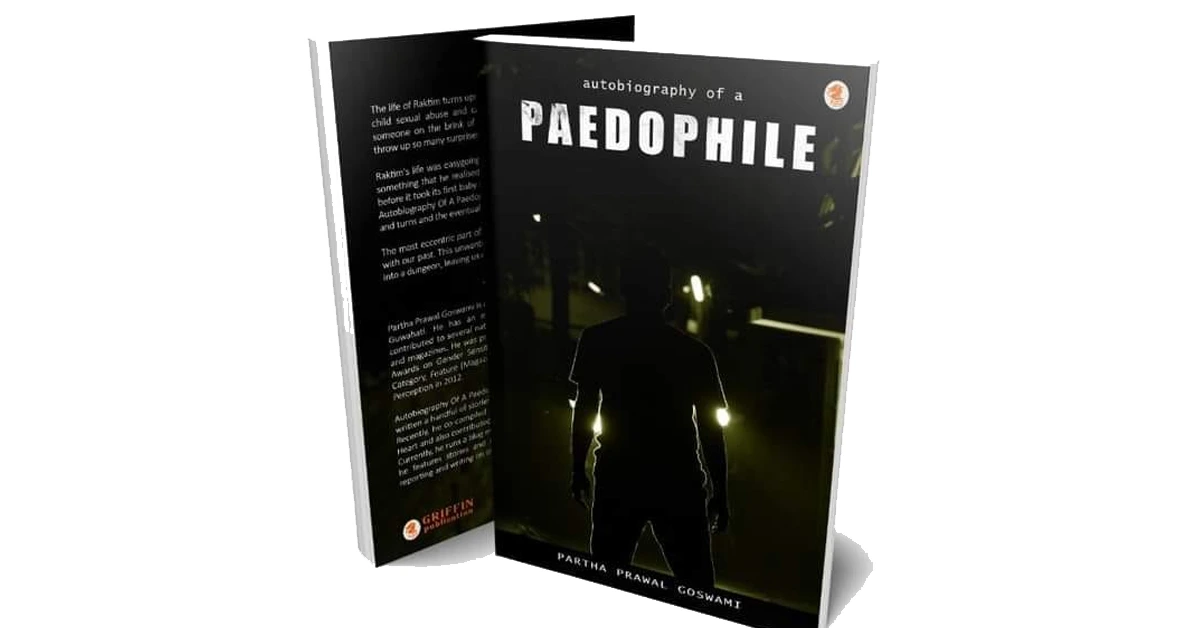
ALSO READ | Autobiography Of A Paedophile And My Journey

Partha Prawal (Goswami) is a Guwahati-based journalist who loves to write about entertainment, sports, and social and civic issues among others. He is also the author of the book ‘Autobiography Of A Paedophile’.