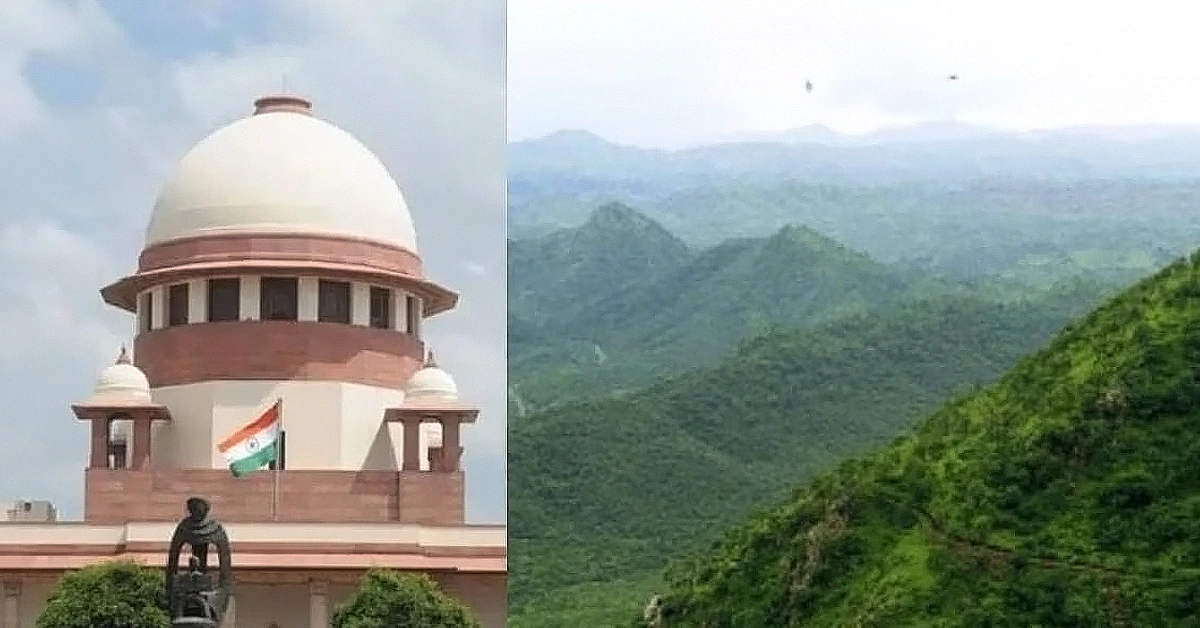
The Supreme Court on December 29, 2025, Monday, put in abeyance its November 20, 2025, ruling that had adopted a uniform, height-based definition of the Aravalli Hills and Ranges, after a wave of objections and applications warned the move could dilute safeguards for one of north-west India’s most fragile ecological belts.
A three-judge bench led by Chief Justice of India Surya Kant said several issues arising from the earlier judgment required clarification and that the court did not want “irreversible” administrative or environmental consequences to flow from a framework that is now being contested on scientific and legal grounds. The bench indicated it would constitute a fresh high-powered expert committee to re-examine the definition and its ecological implications, including what gets included or excluded on the ground.
Why The Court Hit Pause
At the heart of the dispute is the “100-metre” criterion that effectively ties protection to elevation. Conservationists and legal observers argue that the Aravallis are not a single neat ridge but a broken, ancient system where low-lying hillocks, foothills and connecting corridors often carry the same ecological value as higher formations. They say a height-only filter risks carving out large portions of the landscape from scrutiny, creating a backdoor for mining, construction and real estate activity in areas that function as buffers against desertification, recharge groundwater, and hold remaining forest patches around the NCR and Rajasthan.
The court’s latest order reflects concern that the earlier committee’s recommendations—and the court’s own observations—were being interpreted in ways that could weaken protection, or encourage a rush of activity under a newly narrowed definition.
Mining And The Interim Restraint
Even as it paused the redefinition, the bench maintained that the Aravalli question cannot be treated as a routine mapping dispute because it directly affects regulation of mining, including stone and minor minerals. The court’s stance also keeps the pressure on authorities to prevent a regulatory vacuum: the central worry is that once boundaries are relaxed, enforcement becomes harder, and damage becomes difficult to reverse.
The Aravallis have a long history of litigation and court monitoring linked to illegal mining and environmental degradation. Previous judicial interventions were shaped by repeated allegations that mining continued despite restrictions, aided by weak enforcement and the high profitability of construction material supply chains.
Questions Over "Expertise"
The controversy has also drawn attention to how the earlier definition was arrived at. Critics have questioned the composition of the panel that framed the height-based approach, arguing it lacked adequate independent scientific representation and relied too heavily on bureaucratic inputs for a decision with large ecological consequences. The Supreme Court’s decision to call for a new, independent expert assessment signals that it wants a more defensible, science-led basis before any definition is operationalised.
Political Heat, Wider Public Attention
The ruling has triggered sharp political reactions across states touched by the Aravalli system—Delhi, Haryana, Rajasthan and Gujarat. Opposition leaders have portrayed the pause as a judicial correction to what they describe as an attempt to weaken environmental protections, while the Union environment minister has welcomed the stay and said the government will extend cooperation for protection and restoration efforts.
What Happens Next
The matter is expected to be taken up again on January 21, 2026, by which time the court is likely to outline the scope, composition and mandate of the new expert committee. Until then, the pause means the November framework cannot be used as a definitive yardstick for decisions that could change land-use outcomes across the Aravalli belt.
For environmentalists, the immediate relief is the court’s signal that the Aravallis will not be reduced to a single number. For governments and regulators, the message is equally clear: any workable definition must be robust enough to stand scientific scrutiny—and strong enough to prevent the old cycle of “paper protection” and ground-level depletion.
ALSO READ | Delhi’s Toxic Air And The Politics Of Excuses

The Story Mug is a Guwahati-based Blogzine. Here, we believe in doing stories beyond the normal.