Arriving at the office on time and leaving on time is something most people follow without thinking much about it. They come in at a fixed hour, go through the day, finish what needs to be done, and leave when it's over. There are a few who stay back, sometimes because they have to, sometimes because they choose to. But most don't. Raktim was one of them.
He came in on time, did his work, and left on time. It was not something he planned or thought about. It was just how his days went. On most evenings, he followed the same routine without much change.
Raktim worked for an Advertising and PR company, though his own role had little to do with the creative side. He was part of the administrative department, handling the quieter, less visible work that kept everything running smoothly.
By six, the administrative team would begin to wind down. Chairs moved back, systems shut, and conversations slowly faded into the corridor.
But the building itself did not sleep so early. The advertising and PR department, which occupied another floor, often worked longer, sometimes till midnight or beyond. Lights would still glow across the building, giving the place a strange, half-awake feeling.
The office was located in the busy GS Road area of Guwahati and spanned four levels.
The ground floor was reserved for parking. The first floor housed the front office, the small and cosy lobby area, the cabins of the two bosses, a library, a conference room, and a few storage spaces, where movement was steady during the day but slowed sharply by evening.
The second floor was where most of the advertising and PR work happened, usually more active and alive even in the later hours.
The third floor housed Raktim's administrative department, a quiet, work-focused space where most days felt much the same.
The fourth floor had a cafeteria that stayed open late, often carrying the distant hum of voices and the clink of cups.
Above that was the terrace, open to the sky and mostly empty on regular days. It had a small recreational area with a billiard table, a carrom board, and a corner where employees gathered for brief smoke breaks or occasional after-office get-togethers. From there, the city stretched out below, as if the terrace stood quietly watching over it like a silent guardian.
Raktim was used to this environment. He kept to his routine, finished his work on time, and left without much delay. He preferred not to linger.
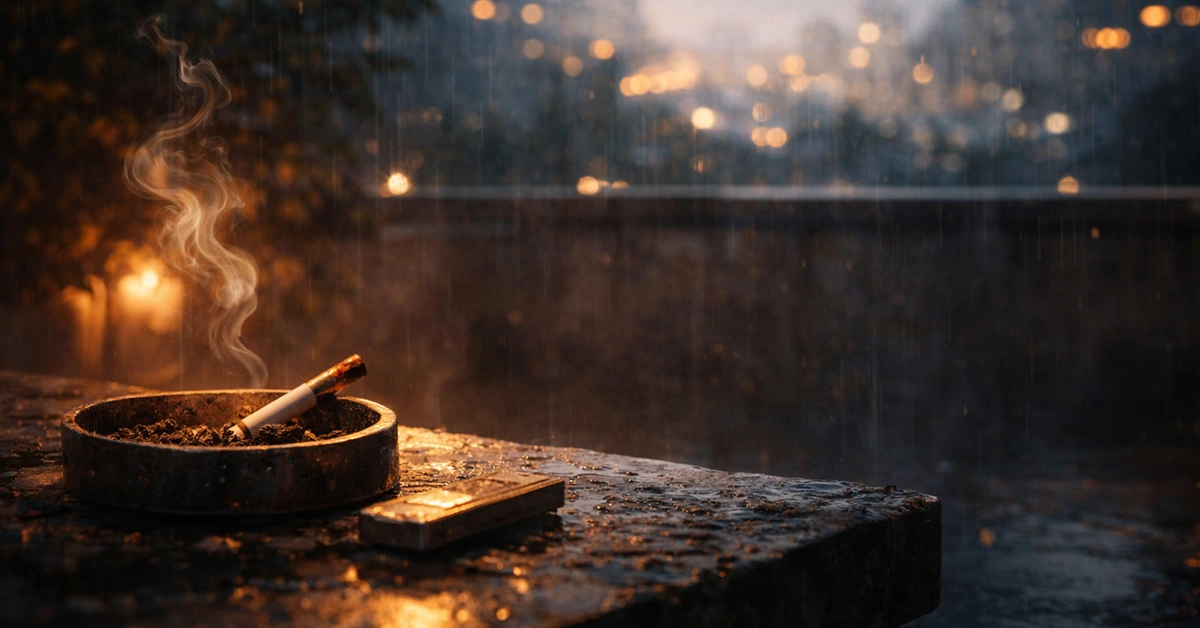
On most days, before leaving, he would take the stairs up to the terrace with a cup of strong black coffee and a cigarette. It was a quiet ritual he never spoke about. The terrace was usually empty at that hour, open to the sky and the distant sounds of the city.
He would stand near the edge, taking slow sips of his coffee, watching the chaos below. Lines of vehicles stuck in traffic, horns rising and falling without rhythm, people moving in hurried patterns that never seemed to settle. From that height, it all looked distant, almost detached.
He did not think much during those moments.
He simply stood there, smoking, watching, letting the noise remain far away before he stepped back into it again.
Mostly, it was him alone on the terrace, while on occasion a few of his HR colleagues would join him, mostly venting their frustrations and sometimes "bitching" about their otherwise "cool bosses."
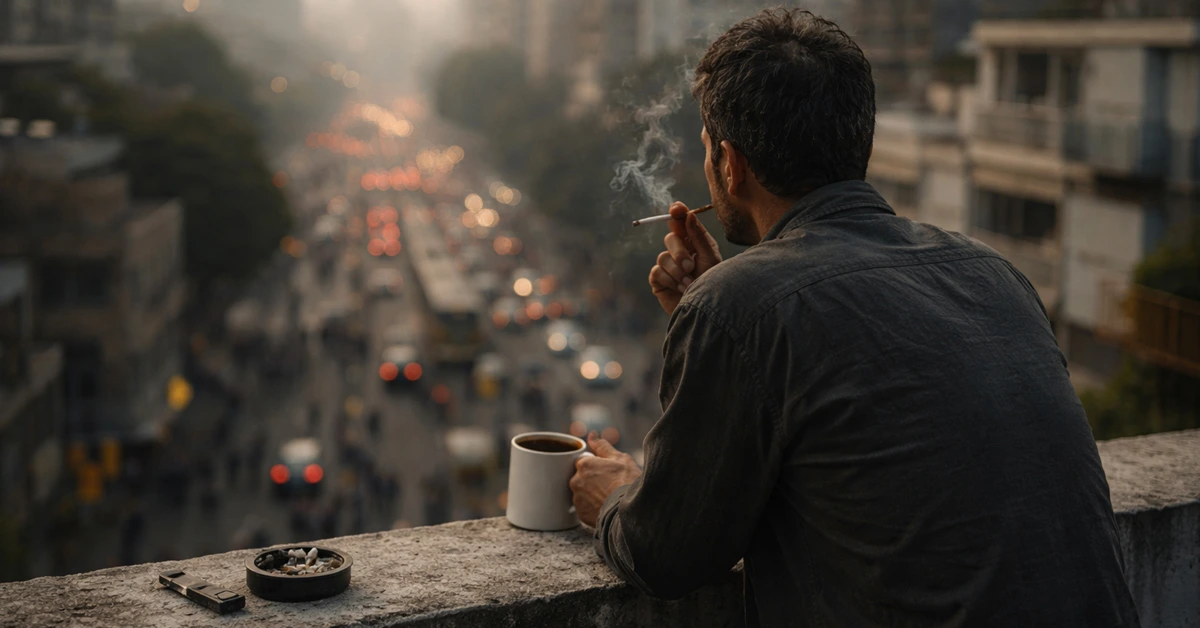
It was the first weekend of the month. He had plans; he was meeting his long-time college friend at a third friend's house for a small get-together. As usual, he was up at his favourite spot on the terrace, enjoying his smoke and a cup of strong black coffee, when out of the blue, he felt someone else was also there on the terrace with him. He thought he had noticed something different.
At the far end of the terrace, near the darker corner where the lights did not fully reach, there would be a faint silhouette. Someone standing still. A woman, from what he could make out. The small glow of a cigarette would appear and disappear in the dimness.
And then the sightings became quite regular as he had seen it on more than one evening.
He never went closer. Never tried to see who it was. It felt like a private moment that did not belong to him.
So he let it be.
The woman was Sanjukta, a woman in her late twenties.
She had joined the organisation only a few weeks ago in the administrative department. Like many new employees, she was still finding her place, still adjusting to the office's rhythm and the quiet expectations that came with it.
Those brief moments on the terrace were her own- a cigarette, a pause, a few minutes away from everything. No conversations, no roles to play. Just silence.
Downstairs, in the third-floor office, she was simply another colleague.
She was briefly introduced, assigned work, and integrated into the system. For the first few days, she remained just another presence in the room. Quiet, attentive, and efficient.
Her presence was felt, though it was not deliberate on her part; she was noticed.
Raktim also noticed her. He noticed Sanjukta the way one notices something slowly, not all at once.
It began with small things. The clarity with which she spoke. The way she listened without interrupting. The fact that she never rushed through her work, yet never seemed delayed, either.
And then, one evening, as she stepped out of a meeting and passed by his cabin- her figure faintly visible through the frosted glass- something about her felt familiar in a way he could not immediately place.
It took him a moment.
Then it connected.
The terrace.
The silhouette.
He did not say anything. He was not even sure if he was right.
But after that, he began to notice her a little more.
Their first few interactions were still strictly professional.
She would walk into his cabin with files, ask what was needed, and leave once the work was done. There was no unnecessary conversation. No hesitation.
But over time, those interactions began to stretch.
A question would lead to a discussion. A discussion would drift into something lighter. Sometimes there would be a pause that neither of them felt the need to fill immediately.
It was subtle.
Easy to ignore if one wanted to.
One evening, as most of their department packed up to leave, Sanjukta paused at his door.
"Do you always leave on time?" she asked.
Raktim had looked up, slightly surprised. "Almost every day, yes."
"That's rare," she said with a faint smile. "People usually try to stay visible."
"I prefer finishing work over showing it," he replied.
She nodded, as if that answer made sense to her. Then she left.
It was a small exchange. But it stayed.
After that, their conversations became a little easier. Not frequent, not deliberate, but comfortable when they happened.
It was Bohag Bihu time, and the office would remain closed for the next three days. The HR had sent out a notice earlier in the week asking everyone to come in traditional attire on the last working day before the three-day break. Most people had followed it without much fuss.
The day was called Traditional Wear Day.
The floor looked different since morning. The usual shirts and trousers were replaced with softer colours and fabrics.
Raktim did not plan much for it, but he still went along. He wore a white dhoti and a matching kurta in traditional Assamese style, with a traditional Assamese gamosa around his neck; something he had not worn to work before. It felt different, a little unfamiliar, but not uncomfortable.
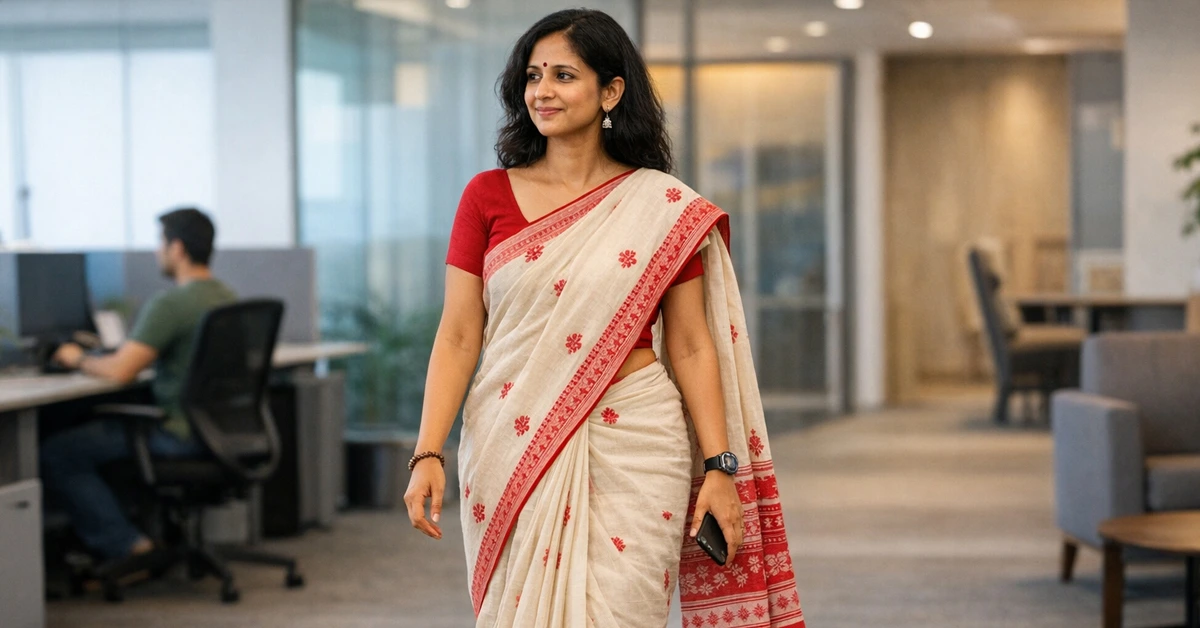
Sanjukta wore a simple handwoven cotton saree with Assamese motifs. It was not elaborate, not something that drew immediate attention, but it stayed in the eye a little longer than expected. She carried it without effort, as if it were just another day for her.
The weather was perfect. The day stayed clear and bright for most of its course. Nothing suggested that it would change towards evening, because, as evening began to settle in, the light started to fade sooner than expected. The sky slowly turned grey, not all at once, but enough to be noticed.
The first drops came without announcement.
Light at first, almost uncertain, tapping faintly against the windows. Then, within moments, the rain gathered itself and began to fall steadily, filling the silence with a soft, constant sound.
That evening, the sky had turned grey earlier than expected.
By the time the clock neared six, most people had already left. Not just the corridor on the third floor had grown quiet, but the entire building seemed to have fallen silent. It seemed everyone had already left the office.
Raktim stayed back, which was unusual for him, to finish a few pending tasks. He did not want to take work home and ruin his Bihu holiday.
Raktim watched the rain through his glass window for a while, then returned to his desk. He was going through a file when he heard hurried footsteps in the corridor, followed by a knock.
"Come in," he said.
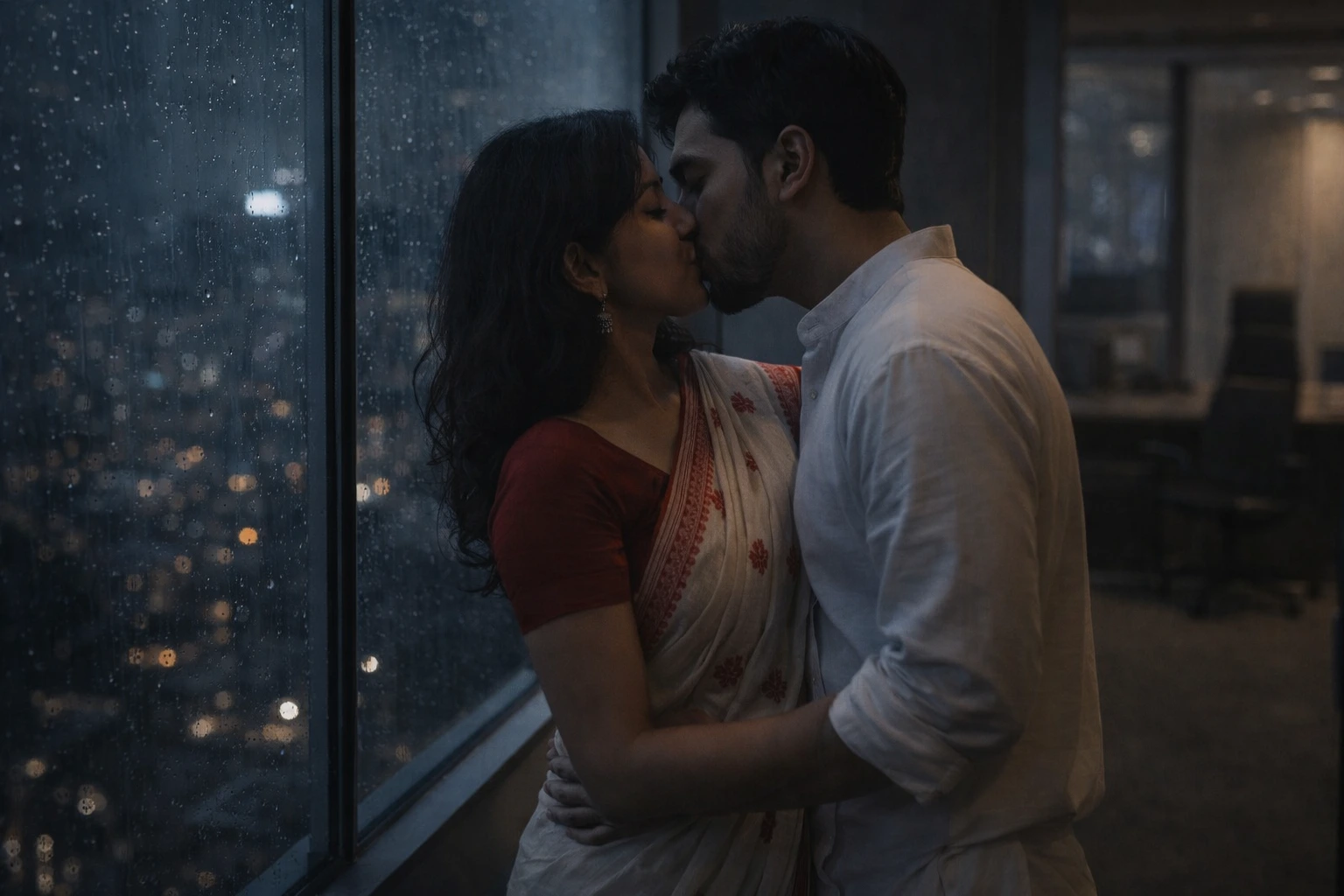
Sanjukta stepped inside, slightly out of breath, a file in one hand and her bag hanging from her left shoulder. The edges of her saree were damp, and a few strands of her hair clung to her cheek.
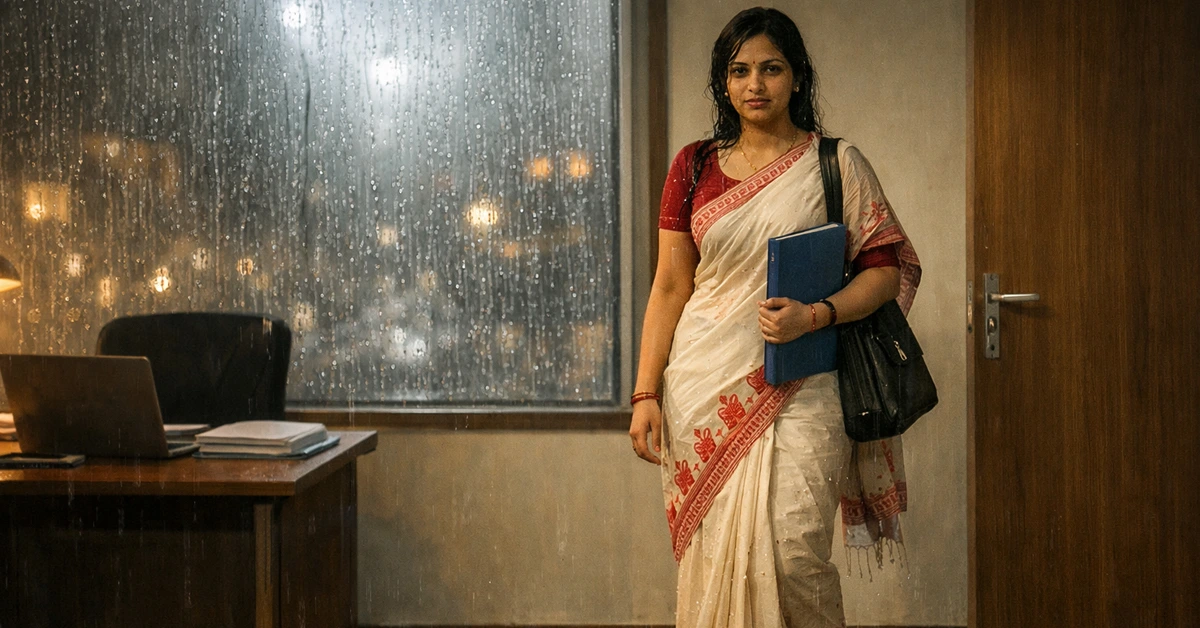
"The rain got heavier than I expected. I had reached the exit but had to dash back," she said.
Raktim glanced at her, then at the faint drops on her shoulder.
"You could have waited downstairs. There is no one on the floor, it's just me, and now it is you, just the two of us now."
"I did," she replied, stepping further in. "But it was getting crowded. I thought you might still be in your cabin, so I came here instead of waiting down. And so what if it is just us? Does it make you comfortable and scared?"
He was slightly baffled. Raktim studied her once again, from top to bottom. A brief pause followed.
"So your intuition pulled you here," he said, a tone slightly serious and slightly inquisitive.
She nodded and asked, "Yes. Why did you ask again?"
"Nothing. Just," Raktim replied and opened the window of his cabin behind his chair.
A sudden gust of wind rushed in, carrying the smell of rain. The room cooled almost at once, the still air breaking as the curtains shifted slightly and a few loose papers on the table moved.
He stood by the window and let the cool wind caress his face and play with his slightly ruffled hair.
He reached for the cigarette pack kept on his table, took one out, and lit it. For a moment, he stood there, taking a slow drag, looking out at the rain.
Then he glanced at her and held the pack out.
"Want one?" he asked, almost sure she wouldn't reject the offer.
Sanjukta shook her head. "No."
He paused, then said quietly, "I have seen you on the terrace. A few times."
She looked at him, a little surprised, then gave a small, knowing smile.
"You have not said anything about it."
"Didn't feel like I had to."
She hesitated for a moment, then stepped a little closer, placing the file on his desk as if to steady herself. She slipped the bag off her left shoulder and placed it on a chair near the desk.
"Fine. Just one," she said.
She adjusted the saree at her shoulder and tried to gather her slightly wet hair into a loose bun, but it kept slipping through her fingers.
He handed her a cigarette and a lighter. She lit the cigarette. For a brief moment, neither of them spoke.
The rain grew steadier outside.
"This also needed your signature," she said, breaking the silence and pointing to the file on his desk, though it did not seem urgent.
Raktim gave a gentle smile.
"You always carry work. Is it natural, or do you carry it as an excuse?" he asked, stubbing out his cigarette in the ashtray before reaching for another.
Sanjukta looked at him, amused.
"Only when I need one."
"And today? Excuse or deliberate?" he asked, lighting it, then holding the pack out towards her.
She held his gaze for a moment.
"None. Today, I did not feel like standing there, crowded and surrounded," she said softly. She put out her cigarette in the ashtray and reached for the pack herself.
The honesty in her voice was quiet, but clear.
Raktim leaned back slightly, taking a slow drag from his cigarette.
"We have been talking more than necessary these days."
"Have we? If so, then why didn't we catch up for a smoke earlier?" she asked.
"Well… you come in with work and…" he paused, as if unsure how to put it.
He took a slow drag before continuing.
"You come in with work almost every day. But you don't leave immediately after it's done. We… we end up talking. Things that could easily be avoided," he said.
Sanjukta gave a faint smile.
"You have never asked me to leave. Or shown signs that you do not like me sitting here and talking. So...you are scared, and also nervous, aren't you?"
That made him pause.
He turned and reached back to close the window.
The rush of wind softened, and the room settled again. He took another drag, then moved back to his chair and sat down, his eyes still on her, as if trying to understand something he had not named yet.
There was something in his gaze. Not direct, not careless either. His gaze seemed magnetic. She felt it.
"Do you want me to?" she asked straight- her voice steady, but soft.
Raktim seemed taken aback. He stubbed out his cigarette and stood up.
"No," he said.
"But I want you," she murmured to herself, barely audible.
"What?" Raktim asked.
"Did you say something?" He looked at her, as if making sure he hadn't missed something.
"Well, I did not come here just because of the rain, or I felt crowded and surrounded," she said, her voice lower, but clear and audible.
Raktim looked at her, a bit confused.
"I have noticed you on the terrace… those evenings. You stand in the same place. The ritualistic black coffee and two cigarettes. Almost an everyday ritual. Not doing much. Just… there," she continued.
"The unhurried charisma you carry is intoxicating. It feels… cerebral, as if it speaks to the mind before anything else. There is something about it that draws me in."
A faint pause. "I never thought I would say this, but... Well, I did drop many hints. But I guess..."
Raktim said nothing. He only listened. He did not show any expression.
"It wasn't anything I planned, or I did not think much of it at first. But...it ignited, slowly," she went on.
Their eyes met again. The room fell quiet. Raindrops tapped steadily against the window in the background, filling the silence.
She heaved a deep sigh.
"Well, as I said, I did not come here just because of the rain or because I had nowhere else to go. And yes, I did say I want you," she said simply.
For a moment, neither of them moved.
Their eyes met and stayed there, steady, unflinching. No hesitation, no looking away. It was not a long moment, but it held longer than it should have.
The word stayed between them.
Sanjukta exhaled slowly, as if something inside her had settled. She stepped closer to the desk, placing her hand on it lightly.
"You know this is not simple," he said.
"I know," she replied.
"But it is also not nothing," she added quickly, looking straight into his eyes.
Raktim did not respond.
He stayed where he was, his hand resting lightly on the edge of the desk, his gaze fixed on her. There was no immediate reaction, no words to soften what had just been said. The rain outside had settled into a steady rhythm, filling the silence between them without breaking it.
He looked at her as if trying to read something more than what she had spoken. Something in her expression, in the way she held his gaze without looking away.
His fingers tightened slightly against the desk, then relaxed.
For a brief moment, it seemed like he might step back, say something to bring the conversation to an end, return to what it had always been.
But he did not.
He took a slow breath, his eyes still on her, and then, almost as if the decision had taken longer than it should have, he pushed himself away from where he stood.
He walked around the desk, not hurried, not uncertain, but aware of every step. Then he stopped near her. The space between them felt different. Not uncertain, but aware.
She did not move.
Her eyes stayed on him, steady, without hesitation.
Raktim lifted his hand slightly, as if to reach for her, but stopped midway. His fingers hovered for a moment before falling back.
He glanced towards the door, then towards the window, then back at her again, as if checking something he could not see.
She noticed.
"The office is empty," she said quietly.
Raktim did not respond immediately. His eyes stayed on her, but there was a question in them. Not doubt exactly—something more unsettled. As if he was waiting for something to interrupt the moment.
Sanjukta held his gaze for a second, then spoke again. Softer this time.
"You know everyone has left." It was not an explanation—just a reminder.
A small pause.
"The second floor wrapped up early… because of the rain and the Bihu," she added, almost absently. "The cafeteria too."
He did not answer.
She took a small step closer.
"The guards are downstairs. They don't come up at this hour," she added. Her tone was steady. Familiar. As if she was only putting words to something he already knew.
Raktim's expression shifted slightly, but he remained where he was.
"You know how it works here," she continued, quieter now.
A faint pause.
"The main door gets locked… and whoever is last on the floor closes it."
Her eyes didn’t leave his.
"Today… today it is us who will be leaving last." The words settled between them.
Raktim's gaze drifted briefly towards the closed cabin door, as if waiting for a sound from outside- footsteps, a voice, anything that might break what was forming.
There was nothing. Only the steady sound of rain filling the silence.
She did not interrupt it.
"And when we leave," she said after a moment, almost gently now.
"We will lock up and go down." Not reassurance. Just completion.
Raktim looked at her. The hesitation was still there, but it had changed. It no longer searched for a reason. It lingered out of awareness.
She stepped a fraction closer.
"But, if you are still unsure… we can stop," she said.
This time, the reassurance felt complete. Not forced. Just real.
Raktim looked at her, the uncertainty no longer sharp, only faintly present.
She stepped a fraction closer.
"If you are still unsure… or if this does not feel right, we can stop," she said, not breaking eye contact.
Raktim did not answer.
This time, when his hand moved, it did not stop.
Sanjukta turned slightly and leaned forward against the desk, her fingers resting on its edge. It was a small, natural movement, but it changed the space between them.
Raktim stood behind her.
Close enough to feel her presence, the warmth of her, the quiet rhythm of her breath.
He paused for a moment.
"Sanjukta…" he called out her name softly.
She did not turn. "You don't have to say anything."
Her voice was calm, but there was a quiet surrender in it.
Her back arched just slightly as she leaned into the desk, and the soft fabric of her saree slipped gently from her shoulder, revealing the curve of her back.
Raktim took a slow breath.
Then he leaned in.
His lips touched her back, soft and unhurried.
Sanjukta's breath trembled, then softened into a quiet exhale. Her eyes closed, her expression easing into something warm and unguarded.
He did not rush.
His affection lingered along her shoulder and the line of her back, steady and deeply felt.
Her hand moved back instinctively, finding his arm, holding onto him lightly.
Outside, the rain continued to fall.
Inside, neither of them stepped away.
And for the first time, nothing needed to be explained.
ALSO READ | A Flight Journey That Did Not End

Partha Prawal (Goswami) is a Guwahati-based journalist who loves to write about entertainment, sports, and social and civic issues among others. He is also the author of the book 'Autobiography Of A Paedophile'.