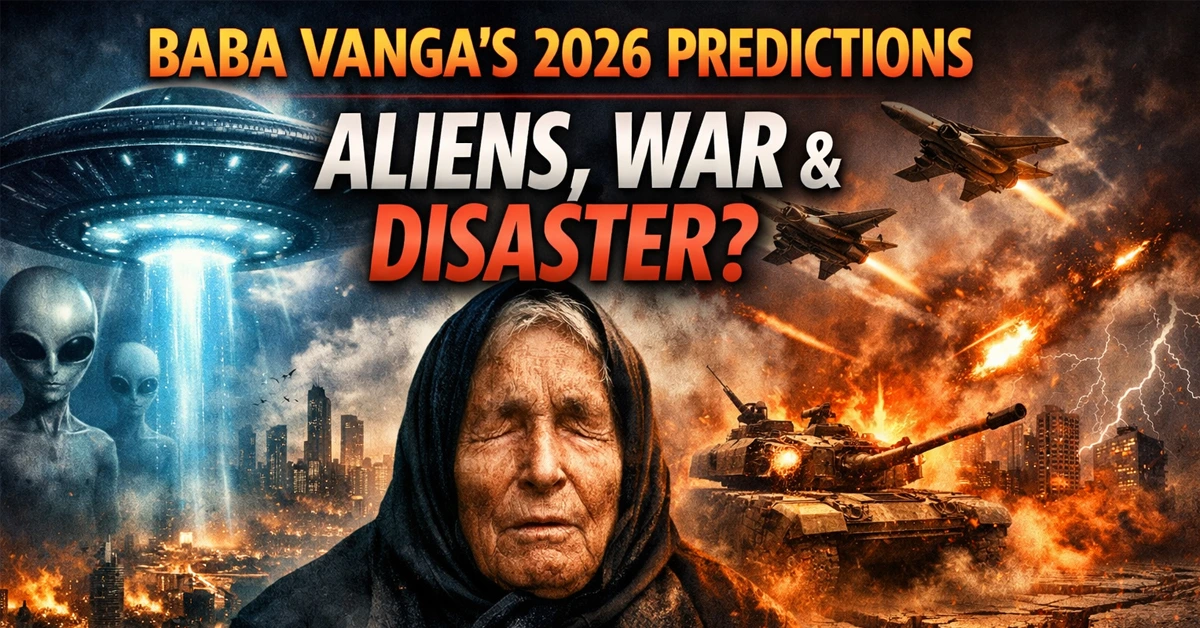
As the calendar edges closer to 2026, the internet has once again revived a familiar name — Baba Vanga. Dubbed by admirers as the "Nostradamus of the Balkans", the late Bulgarian mystic has re-entered global discourse through viral posts claiming she foresaw a series of dramatic events set to unfold in the coming year.
From talk of an alien encounter and a full-scale global war to devastating natural disasters and economic collapse, a growing number of online lists are attributing a fresh set of ominous forecasts to Vanga, fuelling curiosity, fear and widespread speculation.
What Are The Claims Doing The Rounds?
The most frequently circulated narratives suggest that 2026 could mark a turning point for humanity. Among the most sensational claims is the possibility of contact with extraterrestrial life, with some viral posts alleging that a large-scale sighting or interaction could occur during a global sporting or mass event.
Another claim gaining traction revolves around the outbreak of a major international conflict, often loosely described as the beginning of a third world war. These assertions are frequently linked, without evidence, to existing geopolitical tensions between major powers, feeding into broader anxieties about global instability.
Alongside war and alien theories, the predictions also speak of intensified natural calamities — powerful earthquakes, extreme climate events and widespread destruction — echoing present-day concerns about climate change and environmental degradation.
The Problem With Posthumous Prophecies
Despite the popularity of these claims, historians and researchers have long pointed out a fundamental issue: most of the predictions attributed to Baba Vanga were never formally recorded during her lifetime. Vanga, who died in 1996, did not leave behind written prophecies. Instead, her visions were passed on orally, later compiled, translated and, in many cases, dramatically reinterpreted.
Over the years, this has led to an expanding list of predictions that appear to grow with every major global crisis. Critics argue that many of these forecasts are vague enough to be retrofitted to real-world events, while others are entirely modern additions shaped by contemporary fears.
Why These Stories Resurface Now
The renewed interest in Baba Vanga’s alleged 2026 predictions reflects the current global mood. Rising geopolitical tensions, wars, economic uncertainty, rapid technological change and renewed fascination with unidentified aerial phenomena have created fertile ground for apocalyptic narratives.
Social media has played a significant role in amplifying these stories, where sensational headlines travel faster than context or verification. Listicles and short-form videos often blend folklore, selective history and present-day anxieties into easily shareable content, blurring the line between myth and reality.
Separating Myth From Measurable Risk
Experts caution that while global challenges such as climate change, armed conflict and economic instability are real and deserve serious attention, attributing them to mystical prophecies can be misleading. Doing so risks shifting focus away from evidence-based analysis and policy-driven solutions.
Rather than viewing viral predictions as warnings etched in stone, analysts recommend treating them as cultural phenomena — reflections of human fear, uncertainty and the desire to find meaning in turbulent times.
The Bottom Line
The dramatic predictions being attributed to Baba Vanga for 2026 are less a glimpse into the future and more a mirror of the present. While they continue to dominate online conversations and fuel speculation, there is no verifiable evidence to support the claim that these events were ever clearly foreseen.
As history has repeatedly shown, the future is shaped not by prophecies, but by human decisions — and those remain firmly within our control.
ALSO READ | Predict Adolescence Depression With This New Tool

The Story Mug is a Guwahati-based Blogzine. Here, we believe in doing stories beyond the normal.