What If… Life Gives It All Back?
October 15, 2026

In every Assamese household —especially in rural households —the bhoral (granary) remains a symbol of preservation—a place where the harvest is carefully stored for the future.
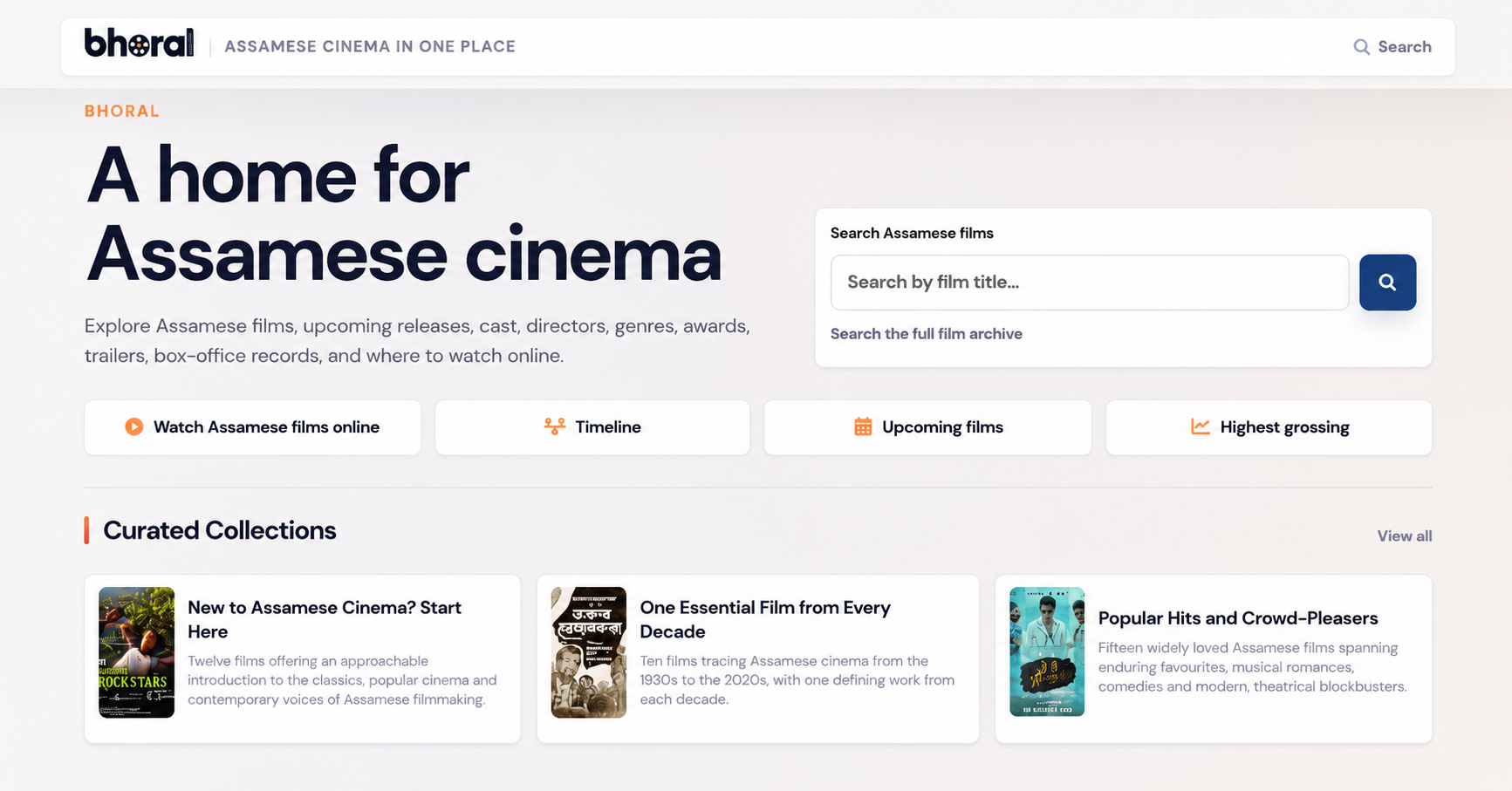
Drawing inspiration from that enduring institution, two passionate admirers of Assamese cinema embarked on a journey to preserve its rich past and evolving present for future generations. The result is Bhoral- which, instead of grains, preserves films, filmmakers and the stories behind them, creating a digital archive for a cinematic legacy that has too often remained scattered, incomplete and at risk of being forgotten.
Despite a history stretching back to Joymoti (1935), Assamese cinema still lacks a single, dependable public record. Information is scattered across old newspapers, books, personal collections and fragmented online sources, where conflicting release dates, incomplete credits and missing records are common.
Curated through meticulous research and verification, Bhoral aims to bridge that gap by documenting Assamese cinema in a structured, searchable and reliable manner.
In this exclusive interview with The Story Mug, Team Bhoral discusses the inspiration behind the platform, the painstaking process of building its archive, the challenges of documenting an industry with fragmented records, and their vision for preserving the history of Assamese cinema for generations to come.
TSM: In Assamese households, a bhoral is where paddy and grains are stored for the future. Why did you choose such a deeply rooted Assamese name for your platform, and what does Bhoral symbolise in the context of documenting Assamese cinema?
Team Bhoral: We grew up with the bhoral, the traditional Assamese granary, as a familiar presence in the courtyard. Harvest season was especially exciting, when the newly harvested paddy was brought home and stored inside it. So when we were brainstorming a name for the website, Bhoral felt immediately right. It was personal to us, and it also captured what we wanted the platform to do.
A bhoral stores the result of months of hard work in the fields. In much the same way, our digital bhoral seeks to preserve the films and the work of filmmakers and other film personalities who have shaped Assamese cinema.
We hope it will keep their stories, credits and contributions accessible for future generations to discover and appreciate.
TSM: Before moving further, please introduce us to Team Bhoral and describe your respective roles.
Team Bhoral: Bhoral is a small, independent project that we work on alongside our regular day jobs. At present, we are a two-person team. We prefer to speak collectively as Team Bhoral because we want the focus to remain on the films and the people whose work we document.
Our responsibilities often overlap, and between us, we research films, verify and maintain the database, develop the website, and manage its editorial content. Since the project is still small, both of us are involved in most parts of the work.
TSM: What was the defining moment that made you realise Assamese cinema needed a dedicated digital archive like Bhoral?
Team Bhoral: There was no single defining moment. The need became clear through repeated attempts to find basic information about Assamese films and discovering how scattered and inconsistent it often was.
A title might appear in one place, a release year in another, and a partial cast list somewhere else. For older or lesser-known films, even simple facts could conflict, and the same mistake was sometimes repeated across several websites.
Over time, that frustration showed us that the information existed, but only in fragments, without a dependable public archive bringing it together in one place.
TSM: Before launching Bhoral, what gaps did you notice in the way Assamese cinema was being documented and archived?
Team Bhoral: The biggest gap was the absence of a single, searchable and consistently organised public record.
Recent films usually left behind promotional material, and a few historically important titles were covered in books or specialist articles, but a large number of films in between had very little accessible documentation.
Bhoral began as an attempt to create that basic structure and bring these scattered records together.
TSM: Will we be wrong if I describe Bhoral as the IMDb of Assamese cinema? Are you comfortable with the comparison, or do you believe Bhoral has a much broader identity and purpose?
Team Bhoral: The comparison is understandable because Bhoral presents structured information about films and film professionals, and describing it that way gives people a quick sense of what the platform does.
At the same time, Assamese cinema has documentation gaps that a general global database may not examine closely enough. IMDb also relies heavily on user-contributed information, which can lead to problems in a smaller film industry, such as direct-to-video (VCD) or web films being listed as theatrical releases.
For Bhoral, the database is the foundation, and we aim to make it a more reliable and searchable source of information on Assamese cinema.
TSM: Was Bhoral conceived primarily as a film database, a digital archive, or did you have an even bigger vision from the very beginning?
Team Bhoral: We began with the film database because that was the clearest immediate need. Before attempting anything larger, we needed a reliable base of titles, dates, credits, posters, awards, filmographies, etc.
At present, Bhoral is primarily a structured digital record. Still, over time we would like it to grow into a broader public resource for Assamese cinema, while remaining careful about the limits of what we can verify and document.
TSM: Building a comprehensive archive of Assamese cinema must have required years of research. How did you begin collecting and verifying information, especially about older films?
Team Bhoral: We did not wait until years of research were complete. We began with a manageable section of recent Assamese films and then worked backwards, year by year.
Older films quickly showed us how difficult the task would be, so we compared online articles, newspaper reports, festival records, award documents, interviews, social media posts and information shared by people connected to the films. No single source is complete, and the work is still ongoing. That is why we are adding a dedicated option on every film page for visitors to report corrections or submit additional details.
We also hope to collect information from older publications as we gain access to them. Contributions from readers, especially about older and lesser-documented films, would help us greatly.
TSM: Which Assamese film was the most difficult to research, and what made it so challenging?
Team Bhoral: It is difficult to single out one film because many Assamese films made before 2010 are challenging to research, particularly those that did not receive major commercial success or critical attention. Sources often provide incomplete or conflicting information.
TSM: Many older Assamese films have incomplete or conflicting records. What methods do you follow to authenticate information before publishing it?
Team Bhoral: We begin by asking where each piece of information comes from. Whenever possible, we check censorship records, contemporary newspaper reports, festival catalogues and other primary or near-contemporary sources.
We also record uncertainty instead of hiding it. A fully confirmed release date is treated differently from a year-only reference. When a detail cannot be verified with reasonable confidence, we prefer to leave the field incomplete rather than present a guess as fact.
TSM: Has your research ever uncovered forgotten facts, lost credits or historical inaccuracies that surprised even the film fraternity?
Team Bhoral: We have not come across anything that we would describe as a major revelation, but we have repeatedly found smaller inconsistencies that still matter.
One particularly head-scratching example came while verifying a film directed by Dinesh Gogoi. Some sources recorded the title as ‘Sanghat’. In contrast, others listed it as ‘Sanghat Sanghat Sanghat’, making it difficult to determine whether they referred to the same film or to two different productions.
TSM: Have filmmakers, actors or their families-both veteran and new- ever reached out to you after discovering that their work had been documented on Bhoral? If yes, could you share one memorable experience?
Team Bhoral: We are still young, so we have not yet had any such cases. The responses we have received from people have been encouraging. We hope that as Bhoral becomes better known, more filmmakers, actors and families will come forward to share information, correct records and help us document work that may otherwise remain incomplete.
TSM: How receptive has the Assamese film fraternity been to Bhoral? Do filmmakers now proactively share information and updates with your team?
Team Bhoral: The response has been positive, though we are still building awareness and trust. We hope that as Bhoral becomes better known, more members of the film fraternity will share updates, correct records and help us fill gaps in the archive.
TSM: Your website openly states that Assamese box-office figures are often incomplete and should be treated as estimates. Why was it important for you to maintain that level of transparency?
Team Bhoral: Because uncertain figures should not be presented as exact historical facts. Assamese cinema does not have a consistent public system for reporting box-office collections, and the figures that do appear may refer to different measures, such as net or gross earnings.
At the same time, audiences are naturally curious about how much a film has earned, so we felt the section was still worth including.
An honest estimate, clearly labelled as such, is more useful than a precise-looking number that cannot be properly verified.
TSM: Do you believe the Assamese film industry now needs a formal and transparent box-office reporting system? What difference would that make?
Team Bhoral: Yes, a formal and transparent reporting system would benefit producers, exhibitors, journalists, researchers and audiences.
At present, commercial success is often discussed through publicity claims or unofficial estimates, which makes meaningful comparison difficult.
Reliable data could help the industry understand audience behaviour, identify underserved districts, track how long films remain commercially viable, and see whether smaller films can build an audience over time.
TSM: How much of Bhoral’s work is driven by painstaking manual research, and how much is supported by technology?
Team Bhoral: Most of our research and editorial judgement is manual. Technology helps us to organise records, search larger datasets, identify possible duplicates and develop the website more efficiently, but its main role is to reduce repetitive work. Verification still depends on careful reading, comparison and an understanding of context.
TSM: What has been the biggest challenge in building and sustaining Bhoral—research, funding, technology, or something else entirely?
Team Bhoral: The biggest challenge is finding dependable information. The technical platform can be improved gradually, and we can keep costs under control by using relatively simple infrastructure.
Research is much harder because older sources may be inaccessible, contradictory or not digitised at all, which makes even basic details difficult to verify with confidence.
TSM: Maintaining a comprehensive digital archive like Bhoral requires considerable time, resources and financial commitment. How do you plan to sustain the platform in the long run? Do you have a revenue model or funding strategy in place to support its continued growth and maintenance?
Team Bhoral: Bhoral is currently an independent project without a fixed revenue model. Our priority has been to build something useful before thinking seriously about monetisation.
Our background in web development helps us keep costs low by choosing affordable tools for hosting and development.
Since the total number of feature-length Assamese films produced since ‘Joymoti’ is still under a thousand, the database remains manageable without a large financial investment at this stage.
TSM: After documenting so many Assamese films, what patterns or changes have you observed in the industry’s journey over the decades?
Team Bhoral: The history of Assamese cinema has not followed a steady upward path. Though the industry has always remained creatively resilient, even when exhibition, distribution, and audience access systems were weak.
One pattern we noticed is the dominance of drama and family drama.
For Assamese cinema to grow into a more varied and mature film culture, we need more films across different genres.
TSM: In your opinion, are there filmmakers or films whose contributions have not received the recognition they truly deserve?
Team Bhoral: It is difficult to measure recognition fairly, but Padum Barua, the director of ‘Ganga Chilanir Pakhi’, is one name that comes to mind.
Nip Barua also deserves renewed attention, especially among younger audiences. Their contributions were very different, but both helped widen the possibilities of Assamese cinema.
TSM: Do you see Bhoral evolving into a valuable research resource for journalists, students, scholars and film enthusiasts, beyond serving as a film database?
Team Bhoral: Yes, that is one of our main goals. We hope journalists, students, scholars and film enthusiasts will use Bhoral as a starting point for deeper work. It is meant to make research easier and more accessible, without trying to replace original research.
TSM: In an age dominated by streaming platforms, social media and rapidly changing digital technologies, why do you think preserving and documenting Assamese cinema has become more important than ever?
Team Bhoral: Online visibility can feel permanent, but it is often fragile. A film can disappear from a streaming platform once a licence ends, and social media posts can be deleted or become difficult to trace over time.
The speed of digital publishing also pushes older information out of view very quickly.
A film that seemed highly visible at the time of its release can become hard to find within a few years. That is why we feel it is important to document and preserve these records while reliable information and original materials are still available.
TSM: If someone possesses rare posters, photographs, documents or missing information about Assamese films, can they contribute to Bhoral? If yes, what verification process do you follow before adding such material to the archive?
Team Bhoral: Yes, such contributions can be extremely valuable. We ask contributors to share as much context as possible, including the source and background of the material, and then compare it with existing records and other available references. If a detail cannot be fully verified, we prefer to mark it clearly as unverified rather than present it as confirmed information.
TSM: Looking ahead, are there plans to expand Bhoral by including oral histories, production archives, interviews, scripts or other historical material?
Team Bhoral: For now, strengthening the database remains our priority. Over time, we would like to expand in other directions, and we are particularly interested in documenting mobile theatres as well, as they are such a unique and important part of Assamese cultural life, in many cases reaching audiences more widely than Assamese films themselves.
TSM: Do you see Bhoral remaining focused exclusively on Assamese cinema, or do you envision documenting films from across the Northeast in the future?
Team Bhoral: Assamese cinema will remain our core focus. At the same time, we have already begun collecting information on films in other languages from the region, such as Bodo, Karbi and Mishing. However, this is not yet available publicly. If we can gather and verify such data more comprehensively, we would be open to expanding the scope of the database in the future.
TSM: If Bhoral had never been created, what aspects of Assamese cinema do you think might have gradually disappeared from public memory?
Team Bhoral: The major classics and popular hits would probably continue to be remembered. What could disappear is the connective detail around them.
Films that were unsuccessful, unreleased or made by less prominent filmmakers face an even greater risk. Some may survive only as titles in old lists.
Bhoral cannot preserve everything, but it can reduce the amount of work future researchers must rebuild from scattered fragments.
TSM: Finally, five years from now, what would you like Bhoral to become, and what legacy do you hope it leaves for Assamese cinema?
Team Bhoral: Five years from now, we would like Bhoral to be the most dependable public starting point for anyone researching or discovering Assamese cinema. That would mean a fuller catalogue, stronger filmographies, better source records, more complete credits, richer historical material and meaningful contributions from filmmakers, researchers and audiences.
We want the platform to remain independent and accessible, and the legacy we hope for is simple: that future generations inherit a strong foundation and have the freedom to build on it further.
If you want to explore this wonderful platform, click here.
ALSO READ | Shut Out At Home: The Relentless Struggle Of Assamese Cinema

The Story Mug is a Guwahati-based independent digital publication focused on news, analysis, commentaries, cinema, literature and culture from Northeast India and beyond.