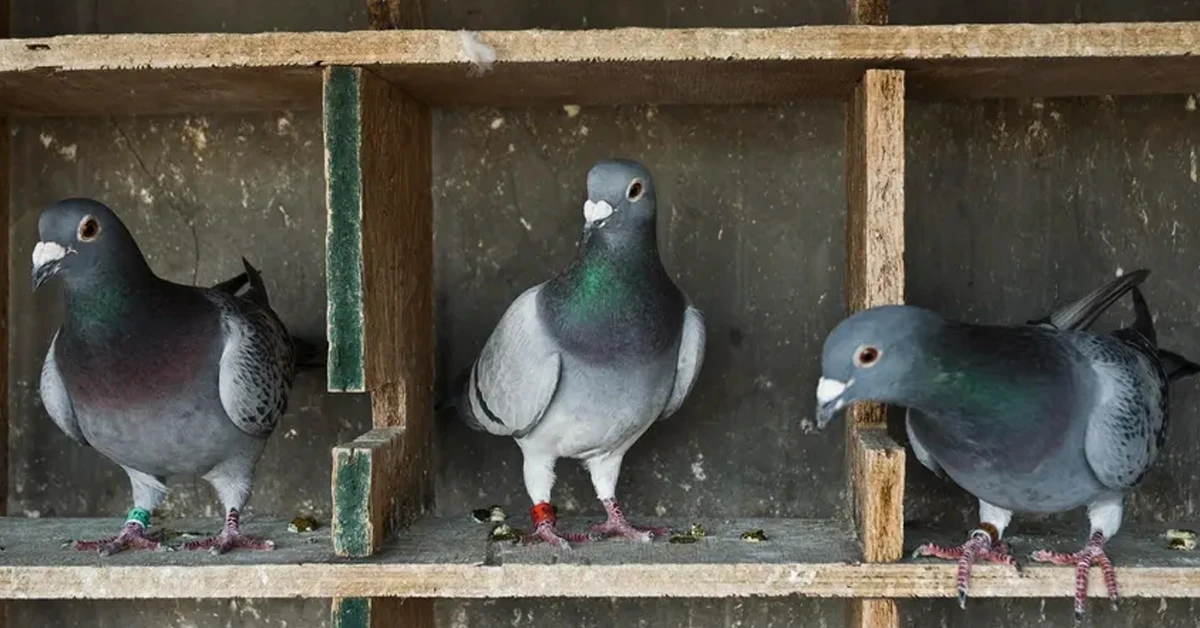
Long before mobile networks and instant messaging, the Odisha Police relied on an unusual but dependable system — a trained pigeon service that carried handwritten notes across vast distances.
In times when telephones failed or were nonexistent in remote areas, these birds became silent couriers of authority, capable of delivering critical instructions with surprising speed and accuracy.
For decades, Odisha maintained what is widely regarded as the world’s last functioning police pigeon communication network.
Even after it was formally discontinued in 2008, the birds were not abandoned. They were retained as part of the force’s heritage, a living reminder of a time when communication depended as much on instinct as on infrastructure.
The pigeon service in Odisha dates back to World War II. At the time, eastern India's coastline was strategically sensitive, and communication facilities were limited, especially in remote districts.
Radio links were unreliable, telephone lines could be disrupted, and large parts of the region had poor connectivity. Carrier pigeons, with their strong homing ability, offered a simple and dependable solution.
After Independence, the Odisha Police chose to continue the service. Natural disasters such as floods and cyclones frequently damage the conventional communication systems. In such situations, trained pigeons provided an alternative way to send short but crucial messages between outposts, district headquarters and command centres.
Handlers maintained lofts, trained the birds regularly and ensured they remained fit for long flights. Each pigeon was conditioned to return to its home base from distant release points, making the system predictable and dependable within its limits.
One of the most frequently cited episodes from this service involves India’s first Prime Minister, Jawaharlal Nehru.
On April 13, 1948, Prime Minister Jawaharlal Nehru was in Sambalpur in western Odisha and needed to send urgent instructions to Cuttack, about 265 kilometres away. Communication options were limited, and time was critical.
At 6 AM, a carrier pigeon was released carrying his handwritten message secured in a small capsule. The bird flew across rivers, forests and plains and reached Cuttack at approximately 11:20 AM — just five hours and twenty minutes later.
When Prime Minister Nehru himself arrived later and was shown the original message along with the pigeon that had delivered it, he was reportedly astonished and delighted.
The story has since become part of the service's institutional memory, illustrating both the speed and reliability of trained homing pigeons.
Maintaining a pigeon communication unit required far more than simply keeping birds in cages. It involved systematic breeding, careful training and constant supervision.
Young pigeons were gradually trained to navigate back to their home loft from increasing distances. They were transported to unfamiliar locations and released so they could develop orientation skills. Only the most reliable birds were selected for official duties.
Messages were written on lightweight paper, rolled tightly and placed in small tubes attached to the bird’s leg. Because pigeons instinctively return to their home loft, communication typically worked in one direction. For a reply, another pigeon trained for the reverse route would be required.
Handlers developed a close bond with the birds. Feeding schedules, health checks and daily exercise were part of routine duty. For the personnel assigned to the unit, this was a specialised role demanding patience and consistency.
By the early twenty-first century, advances in communication technology had made the pigeon system largely redundant. Satellite phones, wireless networks and digital communication tools provided faster, more secure and more flexible options.
In 2008, the Odisha Police officially retired the pigeon service as an operational unit. Maintaining it had become expensive and unnecessary. However, the department chose not to dismantle it completely.
A small number of pigeons continue to be kept for ceremonial and heritage purposes. They occasionally appear during police events and public demonstrations, serving as a living link to an earlier era.
Carrier pigeons were widely used by military forces around the world, especially during the two World Wars. Most such services disappeared by the mid-twentieth century as modern communication systems took over.
What makes Odisha’s case unusual is its longevity. While other regions phased out their pigeon units decades earlier, Odisha maintained one well into the 2000s. This persistence reflected both the state’s challenging geography and a practical approach to emergency preparedness.
The story of the Odisha Police pigeon service is not merely an odd historical anecdote. It represents a period when ingenuity bridged the gap between limited infrastructure and urgent administrative needs.
In disaster-prone regions, having multiple communication options can be critical. Even if rarely used in later years, the existence of a functioning pigeon network provided reassurance that messages could still move when modern systems failed.
Today, information travels instantly across continents. Against that backdrop, a bird covering 265 kilometres in just over five hours may seem slow. In 1948, however, it was a remarkable achievement — and sometimes the fastest option available.
The pigeons no longer carry official dispatches across Odisha’s skies. Yet their story endures as a quiet reminder that communication has always depended on human creativity. Long before signals bounced off satellites, important decisions sometimes arrived on the wings of a bird.
ALSO READ | Rajasthan Police Dig Near Delhi–Mumbai Expressway For Missing Boy

The Story Mug is a Guwahati-based Blogzine. Here, we believe in doing stories beyond the normal.