Zubeen Garg deserved a memorial that reflected the scale of his influence. Instead, he has been given a flood-prone patch of land covered with tarpaulin. The people of Assam have done their part. They have mourned. They have remembered. They still visit. The government, however, seems to have moved on
On September 19, 2025, Assam lost Zubeen Garg, one of its greatest cultural voices. The death of the legendary artist at 52 in Singapore shocked millions across the state and beyond. His passing left a cultural vacuum that cannot be filled by speeches, hashtags, or political statements.
And yet, six months later, the way Assam has treated his memory tells a very uncomfortable story.
On March 13, 2026, Friday, the first rain of the season arrived in Guwahati. It was not a storm or an unusually heavy downpour—just a normal spell of rain. Yet that was enough to expose a deeper problem.
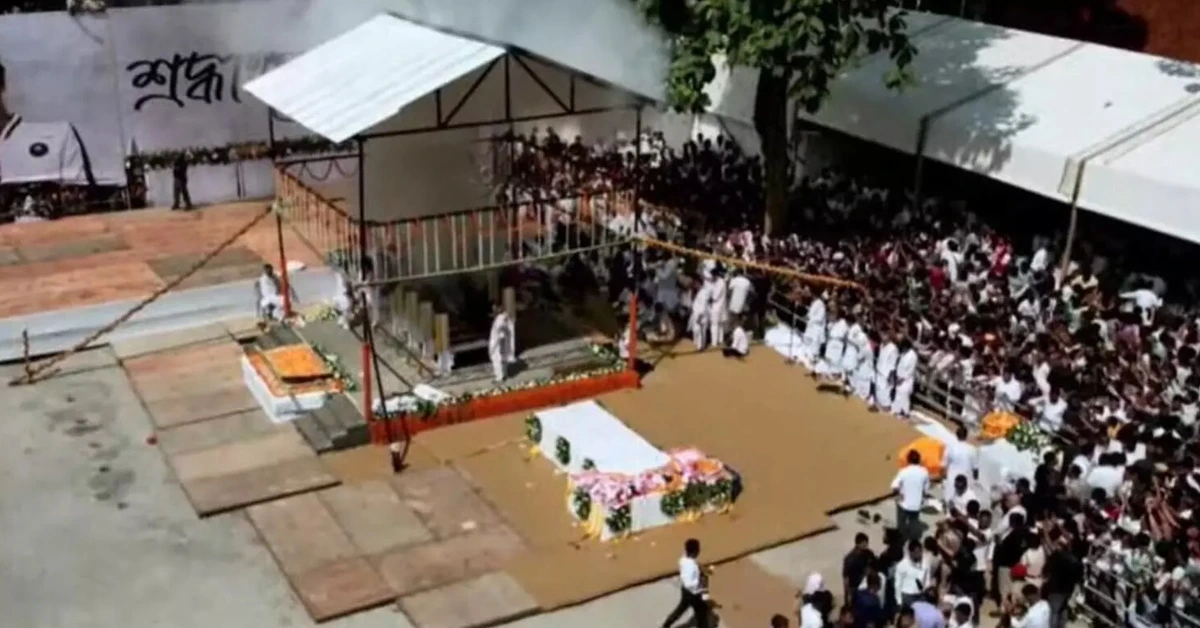
At Zubeen Kshetra in Sonapur—where the singer was cremated and where admirers still come daily to pay their respects—the rain exposed how fragile and neglected the arrangements are. Temporary tarpaulins gave way.
Rainwater entered the area. Candles and earthen lamps lit by fans were extinguished, and tributes left behind by visitors were soaked. What should have been a dignified memorial space instead looked like a poorly maintained temporary site, unable to withstand even the first rainfall of the season.
This was not a natural disaster. This was neglect.
When Zubeen Garg died, the political establishment moved quickly—very quickly—to express grief. Statements poured in. Condolences were tweeted. A three-day state mourning was declared. Leaders across the political spectrum praised his contribution to Assamese culture.
But mourning is easy. Memorialising is work.
Zubeen Kshetra sits on land that was arranged quickly to handle the unprecedented crowd that gathered after his death. Thousands came to pay tribute, and the area soon turned into an emotional pilgrimage site for fans.
Yet months later, the site still appears to be running on temporary arrangements—tarpaulin sheets, makeshift structures and basic arrangements that cannot even withstand a night of rain.
This is not how a society honours its icons.
Since Zubeen Garg's death, the political narrative around him has been dominated by investigations, accusations and headlines. A Special Investigation Team (S.I.T) was formed. Arrests were made. Statements were issued. Political leaders repeatedly spoke about justice and conspiracy.
But while the state machinery busied itself with the politics of his death, the dignity of his resting place was quietly ignored.
That is the contradiction.
The government was energetic when it came to turning the tragedy into a public spectacle—press briefings, investigations, and constant political commentary. But when it comes to building a proper memorial for a man who shaped Assamese music for three decades, the energy suddenly disappears.
A torn tarpaulin now stands where a cultural monument should have stood.
Let us be clear: this is not a question of capability. Assam has built major memorial structures before. The Swahid Smarak Kshetra in Guwahati was completed as a large commemorative complex honouring the martyrs of the Assam Movement.
So the state clearly knows how to build monuments when it wants to.
The question is simpler—and more uncomfortable: Why has that urgency not been shown for Zubeen Garg?
Zubeen Garg was not merely a normal artist or a singer; he was a cultural force. He recorded 40,000 songs in around 40 languages and became one of the most recognisable voices of Northeast India.
For many in Assam, he was not just an artist but an emotional symbol; he was, is, and will always be their beloved Zubeen Da.
His songs defined memories, relationships, and entire phases of life.
That is why fans still travel to Sonapur. They light candles and earthen lamps, and they leave flowers. They stand quietly near the spot where he was cremated.
And then the rain comes.
And the candles go out.
A society reveals its priorities through what it builds—and what it neglects.
Right now, Zubeen Kshetra, the resting place of Assam's most influential contemporary cultural icon, is protected by torn plastic sheets and temporary arrangements. That alone should embarrass the entire political establishment of the state.
Zubeen Garg deserved a memorial that reflected the scale of his influence. Instead, he has been given a flood-prone patch of land covered with tarpaulin.
The people of Assam have done their part. They have mourned. They have remembered. They still visit.
The government, however, seems to have moved on.
And that may be the most disrespectful tribute of all.
ALSO READ | Zubeen Garg...

The Story Mug is a Guwahati-based Blogzine. Here, we believe in doing stories beyond the normal.